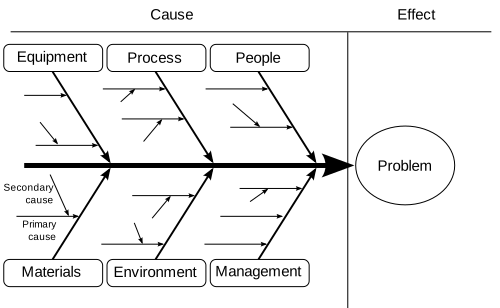
Fish bone diagram
Unmasking the Mystery: Your Guide to the Mighty Fishbone Diagram
Ever felt like you’re staring into the abyss of a problem, with countless potential culprits swirling around like a school of confused minnows? You’re not alone. Businesses everywhere grapple with challenges, and sometimes, the most obvious solutions are buried under layers of complexity. That’s where a legendary tool, the Fishbone Diagram (or Ishikawa, as its creator Dr. Kaoru Ishikawa would proudly say), swoops in like a wise old angler to help you reel in the root cause.
Table of Contents
- Unmasking the Mystery: Your Guide to the Mighty Fishbone Diagram
- What Exactly IS This Fishbone Thing?
- Why Bother? The Superpowers of the Fishbone Diagram
- The Classic Categories: Your Starting Point
- Building Your Own Fishbone Diagram: A Step-by-Step Guide
- Myth vs. Fact: Debunking Fishbone Follies
- Myth:
- Fact:
- Myth:
- Fact:
- Anticipating Your Objections
- Frequently Asked Questions
- The Takeaway
Forget dry, academic jargon. We’re going to break down this powerful problem-solving technique so you can wield it like a seasoned pro, not a nervous intern. Think of it as your strategic detective kit for untangling those knotty business issues.
What Exactly IS This Fishbone Thing?
At its heart, a Fishbone Diagram is a visual roadmap to understanding why something happened. It’s a way to map out all the possible reasons for a specific problem or effect. Imagine the skeletal structure of a fish:
- The "Head": This is your main event – the problem you’re trying to solve, stated clearly. It’s the symptom, the undesirable outcome, the headache you need to cure.
- The "Backbone": A single, strong line leading from the head. This represents the clear path from cause to effect.
- The "Bones": These are the potential causes. They branch off the backbone, fanning out like ribs. You’ll usually group these into major categories.
Why Bother? The Superpowers of the Fishbone Diagram
This isn’t just about drawing a pretty picture. This diagram is a powerhouse for several reasons:
- Team Collaboration Booster: It’s designed for brainstorming. Get your team together, and watch ideas flow! It levels the playing field, encouraging everyone’s input.
- Systematic Thinking: It forces you to look beyond the obvious. Instead of jumping to the first solution that pops into your head, you’re systematically exploring every angle.
- Root Cause Revelation: It’s a detective tool for finding the real source of the problem, not just the symptoms. Like finding the leaky pipe instead of just mopping the floor repeatedly.
- Visual Clarity: Seeing all potential causes laid out visually makes complex issues much easier to grasp. It’s like having a crystal ball for your problems.
The Classic Categories: Your Starting Point
While the specific categories can be customized, Dr. Ishikawa’s original framework, often used in manufacturing, provides a fantastic starting point:
- People: Human error, lack of training, communication issues, motivation.
- Process: Inefficient workflows, outdated procedures, lack of standardization, complexity.
- Materials: Poor quality raw materials, incorrect specifications, supplier issues.
- Equipment: Malfunctioning machinery, lack of maintenance, outdated technology.
- Environment: External factors like weather, market conditions, regulations, office layout.
- Management: Poor leadership, lack of resources, unclear objectives, ineffective policies.
Think of it like planning a blockbuster movie. The "Head" is your critically acclaimed film. The "Backbone" is the core narrative. The "Bones" are all the elements contributing to its success (or failure!): the "People" (actors, crew), the "Process" (filming schedule, editing), the "Materials" (props, costumes), the "Equipment" (cameras, lighting), the "Environment" (studio, on-location), and "Management" (director, producers, studio execs).
Building Your Own Fishbone Diagram: A Step-by-Step Guide
Ready to get your hands dirty (metaphorically, of course)? Here’s how to build one:
- Define the Problem (The Head): Be super specific. Instead of "Sales are down," try "Q3 revenue decreased by 15% compared to Q2." Write this clearly at the right side of your canvas.
- Draw the Backbone: Draw a straight horizontal line from your problem statement to the left. This is the spine of your fish.
- Add the Major Category Bones: Branch off the backbone with diagonal lines. Label each with one of your chosen categories (e.g., People, Process, Equipment).
- Brainstorm Causes (The Little Bones): This is where the magic happens! For each category, ask "Why is this happening?" and list all potential causes. If "Equipment" is a category, causes might be "Machine A is old," "Maintenance was skipped," or "Operator training is insufficient."
- Drill Down Deeper: For each cause, ask "Why?" again. "Machine A is old" might lead to "Older parts are hard to find" or "Newer machines have better efficiency features." This helps you get to the root.
- Analyze and Prioritize: Once you’ve brainstormed, review all the identified causes. Use techniques like dot voting or simple discussion to identify the most likely culprits. Which causes have the biggest impact? Which are easiest to address?
Myth vs. Fact: Debunking Fishbone Follies
Myth:
Fishbone diagrams are only for manufacturing or quality control issues.
Fact:
This is a versatile tool! While born in manufacturing, it’s incredibly effective for analyzing problems in IT, healthcare, customer service, marketing, HR – pretty much any field where understanding cause and effect is key. Think customer complaints, project delays, or high employee turnover.
Myth:
The first cause you identify is usually the root cause.
Fact:
This is rarely true. The power of the Fishbone diagram lies in its systematic exploration and the ‘ask why five times’ principle to dig deeper than the surface-level issues. Jumping to conclusions is the enemy of root cause analysis.
Anticipating Your Objections
- "This sounds like a lot of work. Is it really worth it?" Absolutely! The upfront investment of time in a Fishbone Diagram prevents wasted resources and effort on ineffective solutions. It’s like spending a little time planning a road trip to avoid getting lost for days.
- "What if my team doesn’t agree on the causes?" That’s a sign you need the diagram! It provides a structured, non-confrontational way to bring different perspectives to the table. Facilitate the process to ensure all voices are heard and the most plausible causes are identified through discussion, not just assertion.
Frequently Asked Questions
What’s the difference between a Fishbone Diagram and a simple brainstorming list?
A brainstorming list captures ideas, but a Fishbone Diagram categorizes them, showing relationships and helping to visualize the potential impact of different cause categories. It provides structure and focus that a simple list lacks.
How many causes should I identify?
Focus on quality over quantity. It’s better to have a few well-analyzed, deeply explored potential causes than a long list of superficial ones. Aim to identify the most *plausible* causes that are significant enough to warrant investigation.
Can I use this diagram to find solutions?
Yes! Once you’ve identified and prioritized the root causes, the diagram becomes a powerful foundation for developing targeted solutions. You know exactly where to focus your problem-solving efforts.
The Takeaway
The Fishbone Diagram is more than just a chart; it’s a mindset. It’s a commitment to understanding the ‘why’ behind the ‘what.’ By embracing this visual tool, you empower your team to move beyond quick fixes and tackle problems at their core, leading to more sustainable, effective, and ultimately, more successful outcomes.
Citations:
Ishikawa, K. (1986). Guide to Quality Control. Asian Productivity Organization.
Go From Fish Bone Diagram Back To What Is A Solution Statement