Agile Project Management: The Ultimate Guide to Flexibility & Success
Navigating the Dynamic World of Projects with Agile Methodologies
In today’s fast-paced business environment, traditional, rigid project management approaches often struggle to keep up with evolving client needs and market shifts. This is where Agile project management methodologies shine. Unlike linear, sequential models, Agile emphasizes flexibility, collaboration, and rapid iteration, allowing teams to adapt and deliver value incrementally.
Think of building a house. A traditional approach is like having a complete blueprint before laying a single brick, with every detail finalized. If the homeowner decides mid-construction they want a different kitchen layout, it’s a major, costly disruption. Agile is more like building in stages. You might start with a functional kitchen that meets immediate needs, and then, based on feedback and evolving preferences, you can adjust the dining room layout in the next phase without derailing the entire project. This iterative process ensures the final product truly aligns with the client’s vision and practical requirements.
Table of Contents
- Understanding Agile Project Management
- Core Principles of Agile
- Popular Agile Methodologies
- Benefits of Agile Project Management
- Implementing Agile Methodologies
- Challenges and How to Overcome Them
- Agile in Different Industries
- Frequently Asked Questions
- References
Understanding Agile Project Management
Agile project management is an iterative approach to delivering a project throughout its development lifecycle. Originating in software development, its principles have been widely adopted across various industries due to their effectiveness in managing complex projects with uncertain requirements. The core idea is to break down large projects into smaller, manageable increments, fostering continuous feedback and adaptation.
This approach is particularly effective when the end goal is not entirely defined at the outset, or when rapid delivery of a minimum viable product is crucial. It champions a problem-solving mindset, where understanding the core issue is paramount. For instance, clearly defining the problem before seeking solutions is a fundamental aspect, similar to articulating What Is The Purpose Of A Problem Statement In A Project before embarking on a project.
Core Principles of Agile
The Agile Manifesto, published in 2001, outlines 12 principles that guide Agile practices. These can be summarized into four core values:
- Individuals and interactions over processes and tools
- Working software over comprehensive documentation
- Customer collaboration over contract negotiation
- Responding to change over following a plan
These principles encourage teams to be adaptable, customer-centric, and focused on delivering tangible results efficiently. Effective communication, a cornerstone of Agile, is also vital for leaders to master, much like Active Listening for Leaders: The Unsung Hero of Effective Management.
Popular Agile Methodologies
Several frameworks implement Agile principles. The most prominent include:
Scrum
Scrum is a highly popular framework for Agile project management. It’s designed for teams to work together to achieve a common goal, breaking down complex projects into manageable, iterative cycles called "Sprints." Each Sprint typically lasts 1-4 weeks and results in a potentially shippable product increment.
Key roles in Scrum include the Product Owner, Scrum Master, and the Development Team. Meetings like Daily Scrums, Sprint Planning, Sprint Review, and Sprint Retrospective ensure transparency, inspection, and adaptation.
Kanban
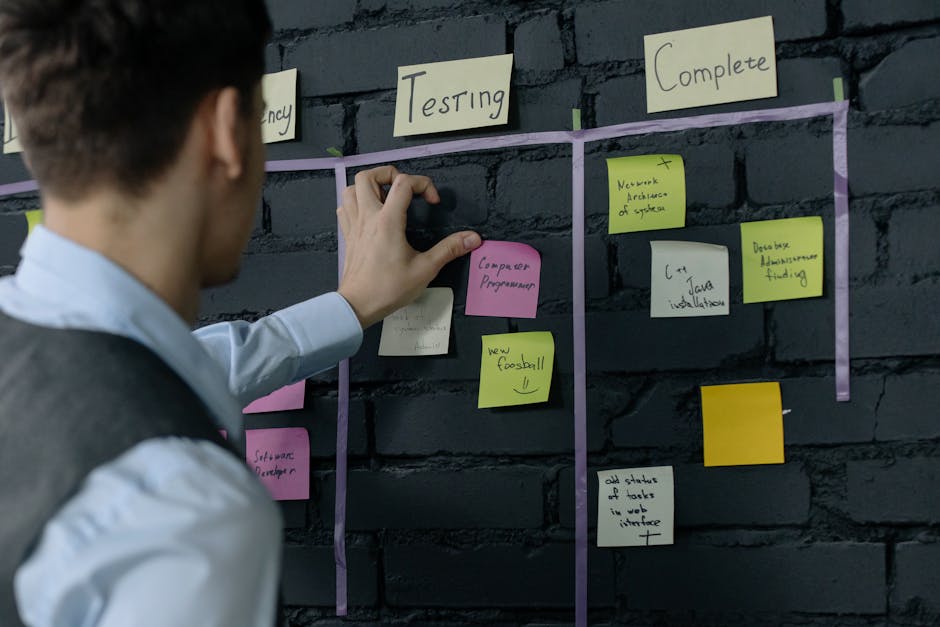
Kanban, a Japanese word meaning "visual signal" or "card," is a method for visualizing workflow, limiting work in progress (WIP), and maximizing efficiency. It uses a Kanban board to track tasks as they move through different stages of the development process. The focus is on continuous flow and identifying bottlenecks.
Kanban is excellent for teams that need a flexible approach and can adapt to varying workloads, making it a valuable tool in areas like Supply Chain Management: The Ultimate Guide to Efficiency & Resilience.
Lean
Lean is a methodology focused on maximizing customer value while minimizing waste. Originating from manufacturing, Lean principles emphasize continuous improvement, respect for people, and optimizing the entire value stream. Key Lean concepts include identifying and eliminating waste (mova), building quality in, creating knowledge, deferring commitment, delivering fast, respecting people, and optimizing the whole.
Lean principles are closely related to improving processes, as seen in Master Process Improvement Methodologies: A Comprehensive Guide.
Extreme Programming (XP)
Extreme Programming (XP) is an Agile framework that aims to produce higher quality software and improve the quality of life for the development team. It emphasizes technical practices like pair programming, test-driven development (TDD), continuous integration, and frequent releases. XP is well-suited for projects with rapidly changing requirements.
Benefits of Agile Project Management
Adopting Agile methodologies offers numerous advantages:
- Increased Flexibility and Adaptability: Agile teams can quickly respond to changes in requirements or market conditions.
- Faster Time to Market: Incremental delivery means functional product versions can be released sooner.
- Improved Quality: Continuous testing and feedback loops lead to higher product quality. Implementing robust Quality Management Systems Implementation: Your Step-by-Step Guide to Excellence can further enhance this.
- Enhanced Customer Satisfaction: Close collaboration ensures the final product meets customer needs.
- Better Team Morale: Empowered teams, clear goals, and visible progress contribute to higher job satisfaction.
- Reduced Risk: Issues are identified and addressed early in the development cycle.
Implementing Agile Methodologies
Successfully implementing Agile requires a shift in mindset and culture. Key steps include:
- Educate Your Team: Ensure everyone understands Agile principles and the chosen methodology.
- Start Small: Begin with a pilot project to test and refine the approach.
- Empower Your Team: Foster a collaborative environment where team members can make decisions.
- Focus on Communication: Establish clear channels for daily interaction and feedback.
- Embrace Continuous Improvement: Regularly review processes and adapt as needed. This aligns with the goals of effective Performance Management Skills: The Ultimate Guide for Leaders.
- Secure Leadership Buy-in: Support from management is crucial for cultural transformation, especially in navigating potential Overcoming Resistance to Change Management: Strategies for Success.
Challenges and How to Overcome Them
While Agile offers many benefits, organizations may encounter challenges:
- Resistance to Change: Employees accustomed to traditional methods might resist the new approach. This requires robust Change Resistance Management: Your Guide to Navigating Organizational Shifts.
- Lack of Clear Vision: Without a well-defined problem or goal, Agile can become unfocused. Ensure clarity, perhaps by revisiting How Does A Problem Statement Differ From A Project Scope Statement.
- Unrealistic Expectations: Stakeholders may expect Agile to be a magic bullet, leading to disappointment if not managed properly.
- Difficulty with Large-Scale Projects: Scaling Agile across multiple teams or large organizations requires careful planning and specialized frameworks like SAFe (Scaled Agile Framework).
Overcoming these challenges involves strong leadership, continuous training, clear communication, and a commitment to the Agile values. Effective Time Management for Leaders: Master Your Schedule, Maximize Your Impact is also crucial for keeping complex Agile projects on track.
Agile in Different Industries
While Agile originated in software development, its principles are highly adaptable:
- Marketing: Agile helps marketing teams respond quickly to campaign performance and market trends.
- Human Resources: Agile can be used for developing new HR policies or managing recruitment drives.
- Manufacturing: Lean and Kanban are closely related to Agile principles, optimizing production flow and inventory, akin to advanced Inventory Management Software: The Ultimate Guide for Business Success.
- Construction: While traditionally rigid, some construction projects adopt Agile for specific phases or project management.
- Healthcare: Agile is being used for developing healthcare IT solutions and improving patient care processes.
Frequently Asked Questions
Is Agile suitable for all types of projects?
Agile excels in projects with evolving requirements, uncertainty, or a need for rapid iteration. For highly predictable projects with fixed scopes, traditional methods might be more suitable. However, the adaptability of Agile principles can often be beneficial even in seemingly predictable environments.
What is the biggest challenge in adopting Agile?
Often, the biggest challenge is cultural resistance to change and a lack of understanding or commitment from leadership and team members. Overcoming ingrained habits and traditional hierarchical structures requires significant effort and consistent reinforcement of Agile values. This is a challenge in any significant organizational shift, similar to Leading Through the Fire: Mastering Crisis Management Leadership in an Unpredictable World.
How does Agile improve collaboration?
Agile methodologies inherently promote collaboration through daily stand-ups, cross-functional teams, and continuous feedback loops. The emphasis on individuals and interactions over processes, and customer collaboration over contract negotiation, directly fosters a more collaborative environment. The concept of adaptive leadership is also critical here, as highlighted in discussions on Neuro-Agile Leadership: Safeguarding Executive Function in R&D After Project Failures.
References
- Agile Alliance
- Scrum.org
- Kanbanize
- Lean Enterprise Institute
- Project Management Institute (PMI) – Agile Resources
- Atlassian – Agile Coach
- MIT Sloan Management Review
- Harvard Business Review
- Forbes – Technology
- ResearchGate – Agile Project Management Studies
Featured image by cottonbro studio on Pexels