Post-Merger Team Topology: 3-Day Agenda (Facilitator Guide)
As an Amazon Associate I earn from qualifying purchases. Product links on this page are affiliate links — they cost you nothing extra.
⏱ 34 min read
Why Post-Merger Integrations Require Team Topology Mapping
Post-merger team topology mapping is a structured 3-day facilitation framework that categorises combined engineering units into four distinct archetypes and three interaction modes to eliminate duplicate systems, clarify domain boundaries, and protect delivery speed across merged companies. Traditional corporate mergers combine software groups using standard administrative reporting lines, which creates overlapping code ownership and cross-team dependencies. By aligning team boundaries directly to software architecture rather than corporate hierarchy, technical leaders establish clear platform ownership within days of deal close.
What happens when you bypass this alignment? The architecture breaks down under the weight of organisational confusion.
In research published by Harvard Business Review, author Roger Martin noted that between 70% and 90% of mergers fail to achieve their stated strategic goals. In technical acquisitions, this failure takes place inside the codebase. The root cause is an organisational principle identified by programmer Melvin Conway in 1967.
Conway’s Law states that an organisation builds software systems that mirror its internal communication channels, meaning split or unclear reporting lines inevitably produce fractured, buggy software architectures.
When two separate engineering units merge without explicit boundary redesign, their communication paths fragment. Two teams continue building separate authentication services, overlapping data pipelines, and competing APIs. Handoffs multiply, release cadences slide from days into quarters, and velocity stalls because no single engineer has authority over an end-to-end user transaction.
This friction exacts a heavy psychological toll through cognitive overload.
Cognitive load refers to the total amount of mental effort and working memory an engineer needs to understand, deploy, and maintain their assigned software systems.
In their book Team Topologies, published by IT Revolution Press, authors Matthew Skelton and Manuel Pais explain that unmanaged cognitive load directly throttles delivery speed.
Recommended gear
Team Topologies, 2nd Edition: Organizing Business and Technology for Fast Flow of Value
Empowered teams and technology-driven organizations can achieve sustained value delivery with this practical, adaptive approach to team topology design.
Affiliate link
After an acquisition, a developer who once maintained 2 internal services often inherits 4 legacy services, 2 deployment pipelines, and shared responsibility for an unfamiliar payment gateway. The 2023 DORA report from Google Cloud found that clear team ownership of software components improves delivery performance by 20%. Without deliberate boundary mapping, developers spend their weeks in coordination meetings instead of writing code, accelerating staff turnover within 6 months of the deal. Engineering leaders frequently combine structural redesign with a Post-Merger Culture Playbook (With 90-Day Plan) and focused initiatives to Dissolve Team Silos: 4-Week Workshop (Agenda).
Practical Scenario: Resolving Duplicate Billing Engines Across Merged Product Lines
Consider a mid-sized software organisation that acquires a competing product and inherits two parallel subscription billing engines. Both original teams claim domain authority over billing, and neither team wants to abandon their codebase.
The engineering director convenes technical leads from both teams for a boundary-mapping exercise. Instead of choosing a single codebase immediately, the leads map all software components against clear customer-facing domains.
Next, the leads apply topology archetypes. They classify the acquiring company’s team as a stream-aligned team focused exclusively on the customer checkout funnel. They reclassify the acquired team as a platform team focused entirely on back-end payment processing and ledger reconciliation.
The critical decision point occurs during the definition of team interactions. If the director simply instructs the teams to collaborate, both continue committing code to the same repositories, generating continuous deployment blockers. Skipping this contract phase leads to delivery paralysis. Instead, the director mandates an explicit interaction mode: close collaboration for a brief discovery phase, transitioning into an ‘as-a-service’ relationship governed by a strict API contract.
The platform team delivers the internal payment API and treats the stream-aligned team as an internal customer. Handoff meetings stop, deployment failures decline, and both groups release features without cross-team approval gates.
Standard org chart consolidation fails because it groups people by corporate titles, functional skill sets, or administrative convenience. That approach forces frontend developers, backend engineers, and quality analysts into separate silos that require endless handoffs to ship one customer feature.
Flow-oriented team topology design works in the opposite direction. It takes the software architecture required to deliver business value and groups people around that flow. By sorting technical units into four archetypes (stream-aligned, enabling, complicated-subsystem, and platform) and enforcing three distinct interaction patterns (collaboration, facilitating, and as-a-service), leaders eliminate architectural overlap and prevent delivery gridlock. Addressing these team dynamics early is an essential part of Troubleshooting Team Dysfunctions before technical friction turns into cultural conflict.
To run this structural realignment before technical debt takes root, you need a strict step-by-step facilitation plan, starting with the Day 1 workshop agenda detailed below.
Key Takeaways
- Team topology mapping resolves redundant software ownership across merged engineering departments in 3 structured days.
- Assign combined staff strictly across 4 archetypes: Stream-Aligned, Enabling, Complicated-Subsystem, or Platform teams.
- Define explicit interaction modes—Collaboration, X-as-a-Service, or Facilitating—to stop cross-department meeting bloat.
- Establish clear Team APIs immediately to protect engineering velocity during post-merger systems integration.
Table of Contents
- Why Post-Merger Integrations Require Team Topology Mapping
- Prerequisites and Participant Selection for the Mapping Workshop
- Day 1 Workshop Agenda: Domain Discovery and Bounded Contexts
- Day 2 Workshop Agenda: Mapping Teams to the Four Archetypes
- Day 3 Workshop Agenda: Interaction Modes and Service Contracts
- Facilitator Scripts for Defusing Common Post-Merger Tensions
- The Complete 3-Day Workshop Facilitation Kit and Checklist
- Sources & Further Reading
Prerequisites and Participant Selection for the Mapping Workshop
A post-merger team topology mapping workshop requires exactly 12 to 16 participants, split equally between both merging organisations, to produce an actionable operating model. Capping the roster at 16 prevents the paralysis common to large committees, while guaranteeing representation across strategy, architecture, and code.
The Mandatory Attendee Roster
Four specific roles from each company must attend all three days:
- Engineering Directors (2 from each side): They hold headcount authority and understand organizational friction.
- Enterprise Architects (1 from each side): They know how systems share data and where technical debt sits.
- Heads of Product (1 from each side): They define domain boundaries and customer value streams.
- Staff or Principal Engineers (2 from each side): They know the production realities and day-to-day deployment blocks.
Do not substitute senior leadership with delegates. When an acquiring company leaves out acquired staff engineers, the resulting structure ignores real technical debt. If you are dealing with friction between legacy managers, review Understanding Power Dynamics in Teams before finalizing the roster.
Team Topologies is an organizational design method that treats software architecture and team structures as a single system to reduce cognitive load and speed up software delivery. In Matthew Skelton and Manuel Pais’s book Team Topologies, the authors demonstrate that misaligned team boundaries create communication bottlenecks that destroy post-merger productivity.
Pre-Workshop Artifacts (Due 5 Business Days Prior)
Do not start the session with blank whiteboards. Five business days before Day 1, both organizations must submit three specific artifacts to the workshop facilitator:
ARTIFACT SUBMISSION TIMELINE
[T - 10 Days]
Issue artifact templates to leads
      |
      v
[T - 5 Days]
Collect 3 core artifacts
- Architecture map
- Bounded contexts
- DORA metrics
      |
      v
[T - 2 Days]
Distribute pre-reads & packet
      |
      v
[Day 1 Workshop]
Start mapping session
- Software Architecture Maps: High-level diagrams showing service boundaries, databases, third-party vendor dependencies, and shared infrastructure.
- Domain Context Boundaries: A business domain context document defining where customer identities, billing, inventory, and analytics begin and end across both platforms.
- Deployment Cadence Benchmarks: Baseline metrics based on the Google Cloud DORA research program, including deployment frequency, lead time for changes, change failure rate, and mean time to recovery (MTTR).
If one organization deploys code 14 times a day while the other deploys once every 6 weeks, forcing them into a shared platform team immediately will fail. Gathering these figures upfront exposes operational divergence before discussions begin. For engineering-heavy groups, using methods from Team Building for Technical Teams helps ground these metrics in everyday engineering realities.
Physical Room Configuration and Off-Site Constraints
Host the workshop at an off-site location at least 5 miles away from both corporate campuses. On-site rooms invite constant interruptions from direct reports, production fire drills, and executive drop-ins.
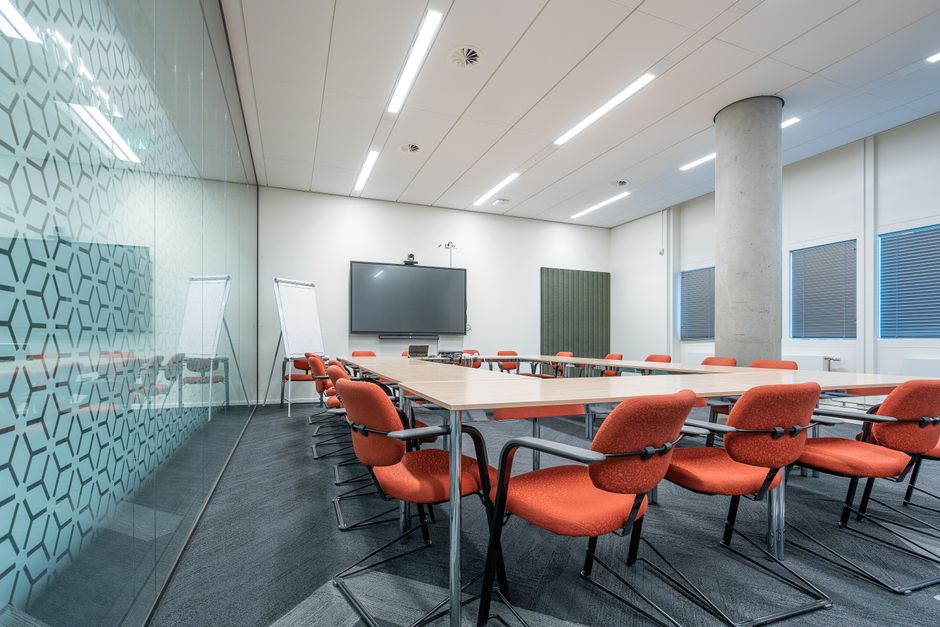
Book a dedicated room with a minimum of 600 square feet. You need at least 30 linear feet of clear whiteboard or wall space to hang paper maps. Arrange tables in a wide U-shape facing the primary wall. Ban laptops and phones during active exercises, reserving two 15-minute device breaks in the morning and afternoon, plus a full 60-minute lunch.
Core Terminology Pre-Reads
Send a two-page executive brief 48 hours before Day 1 covering the four fundamental team types:
- Stream-aligned teams: Teams dedicated to a continuous flow of work tied to a single business capability.
- Platform teams: Teams that provide underlying services to enable stream-aligned teams to deliver autonomously.
- Enabling teams: Specialist teams that teach new practices and tools to remove knowledge gaps.
- Complicated-subsystem teams: Rare specialist teams responsible for a mathematically or technically complex domain, such as a custom cryptographic engine.
To tackle broader cultural friction alongside structural mapping, align this setup with your Post-Merger Culture Playbook (With 90-Day Plan).
Which Preparation Path Fits Your Merger Context?
If both engineering organizations already use microservices and automated CI/CD pipelines…
Skip basic architectural leveling. Spend Day 1 focusing on domain boundaries and platform capabilities, using your DORA metrics to isolate integration points. If inter-team boundaries are already guarded, review Dissolve Team Silos: 4-Week Workshop (Agenda) to align the engineering heads before Day 1.
If one company operates a monolithic legacy codebase while the other runs cloud-native services…
Dedicate four hours of Day 1 to mapping Conway’s Law implications. Assign the acquired monolithic team an Enabling Team pattern to gradually decouple services rather than mandating an instant platform merge.
If product lines overlap directly and sales teams are actively competing for the same accounts…
Require product heads to present a unified value stream map 48 hours before the workshop starts. Do not begin team boundary mapping until both Heads of Product sign off on joint bounded contexts.
With your attendees confirmed, rooms booked, and pre-reads distributed, you are ready to enforce the tight schedule of the Day 1 facilitation script below.
Day 1 Workshop Agenda: Domain Discovery and Bounded Contexts
Day 1 establishes a shared technical taxonomy and exposes software duplication across merging organizations before any organizational reporting lines change. A 2021 study by McKinsey & Company revealed that roughly 70% of mergers fail to achieve their planned technical synergies, usually because leadership reorganizes teams before understanding how software boundaries overlap. Day 1 forces engineering leaders from both acquired and acquiring companies to sit in the same room, map out functional domains, and resolve system conflicts on paper.
A bounded context is a software engineering boundary around a specific business domain model, ensuring that words, data structures, and database schemas carry a single unambiguous meaning within that zone without leaking conflicting definitions outside it. In Eric Evans’s foundational text Domain-Driven Design, clear boundaries protect engineering teams from building tangled, shared-database monoliths. When two companies merge, terms like "Account," "Customer," or "Order" mean radically different things in each codebase.
09:00 to 12:00: Joint Product and Technical Domain Discovery
The morning session breaks the ice between groups who may feel defensive about their architectural decisions. For an effective rollout, combine this architectural alignment with established techniques for team building for technical teams.
Run this 3-hour morning session in three disciplined phases:
- Ubiquitous Language Audit (09:00–10:00): Have each technical lead write down the core entity nouns their systems handle on sticky notes. Compare the definitions of the top 10 nouns across both tech stacks. In one merger, the acquired firm defined a "Customer" as an active monthly subscriber, while the acquiring firm defined a "Customer" as any tenant with a signed enterprise contract.
- Business Capability Mapping (10:00–11:15): Map out what the combined business actually does, stripped entirely of service names and tech jargon. Identify the core income-generating capabilities, supporting functions like billing or compliance, and generic commodity systems like notifications.
- Draft Context Boundary Grouping (11:15–12:00): Cluster related capabilities into 5 to 8 candidate bounded contexts on an open visual workspace using software like Miro or Lucidchart. Do not assign team names to these clusters yet.
13:00 to 15:00: Overlapping Microservices, Shared Databases, and Disputed Boundaries
The afternoon begins by exposing friction points between the two architectures. In their book Team Topologies, authors Matthew Skelton and Manuel Pais emphasize that team boundaries must align to software boundaries to prevent high cognitive load. When two architectures merge, you inevitably find 2 or 3 microservices doing identical jobs and monolithic databases accessed by opposing services.
Facilitate this 120-minute deep dive using the article’s Post-Merger Domain Classification Matrix to sort every contested service into one of four operational categories.
The Post-Merger Domain Classification Matrix
Core Differentiator
Unique capability delivering primary revenue or direct competitive advantage for the merged company.
Belongs here if: It represents intellectual property that directly generates customer revenue and exists in only one of the original stacks.
Then: Preserve current team ownership and isolate the service behind a clear public API.
Redundant Duplicate
Parallel service performing identical work across both legacy platforms.
Belongs here if: Both companies run separate systems solving the exact same operational requirement, such as two billing engines or two auth services.
Then: Select one system to retain within 60 days and schedule the deprecation of the other.
Contested Boundary
Tangled service or shared database accessed by cross-company workflows with no clear single owner.
Belongs here if: Teams from both sides execute write operations to the same datastore or depend on synchronous inter-service calls.
Then: Split into distinct bounded contexts or wrap with an anti-corruption layer immediately.
Commodity Utility
Non-differentiating operational capability that could be fulfilled by commercial off-the-shelf software.
Belongs here if: The service provides no distinct market value, such as raw SMS delivery, email notification queues, or basic PDF generation.
Then: Standardize on a single vendor tool and reassign internal developers to core domains.
This afternoon exercise often surfaces latent friction between acquiring engineering managers and acquired tech leads. Navigating this successfully requires understanding power dynamics in teams to prevent the acquiring firm from steamrolling superior architecture simply by corporate authority.
15:30 to 17:00: Consolidating the Corporate Architecture Map
The final 90 minutes of workshop time convert sticky-note clusters into a single consolidated corporate architecture diagram. Martin Fowler’s architectural writings at Thoughtworks advocate for using "context maps" to document the formal relationships, customer-supplier dependencies, and anti-corruption layers between systems.
Draw the macro-level bounded contexts as large perimeter boundaries. Position individual microservices, legacy monoliths, and third-party SaaS platforms inside those lines. If a single database sits across two bounded contexts, draw a thick red ring around it; this indicates a structural refactoring target that the teams must dismantle over the coming 6 to 12 months.
End-of-Day Checkpoint: The Signed Taxonomy Accord
Day 1 fails if participants leave with competing interpretations of what occurred. By 17:00, you must secure a formal end-of-day checkpoint: a single, shared domain taxonomy document.
This document lists every agreed bounded context, its strict business definition, the designated system of record for that domain, and the deprecation path for redundant services. Both the Chief Technology Officer of the acquiring entity and the VP of Engineering of the acquired company must formally sign off on this map before anyone departs for dinner.
This agreed architectural footing aligns with the governance steps outlined in our Post-Merger Culture Playbook (With 90-Day Plan).
Once engineering leadership signs off on these architectural boundaries, you are ready to evaluate the human side of the equation: measuring team cognitive load and mapping these new contexts directly to sustainable team structures on Day 2.
Day 2 Workshop Agenda: Mapping Teams to the Four Archetypes
Day 2 of a post-merger team topology workshop reorganises combined engineering groups into four distinct operating structures to eliminate delivery bottlenecks and clarify software ownership. Following an acquisition, duplicate engineering squads routinely trip over shared codebases and conflicting roadmaps. In Team Topologies, authors Matthew Skelton and Manuel Pais define these four core team archetypes: Stream-Aligned, Platform, Complicated-Subsystem, and Enabling.
Team cognitive load is the total amount of mental effort required for an engineering crew to build, test, and run their assigned software services. When post-merger teams retain ownership of legacy architectures alongside new integrations, this load exceeds human working capacity, dropping release velocity by up to 40% within the first 90 days.
09:00 to 11:00 — Assessing Cognitive Load Across Merged Squads
Start the morning session by auditing the operational strain on every acquired and legacy engineering squad. Give each team lead 10 minutes to list every domain, repository, pipeline, and internal ticket queue their group currently touches.
In research originating from educational psychologist John Sweller, cognitive load splits into three types: intrinsic (core domain knowledge), extraneous (environmental friction like clunky deployments), and germane (delivering customer value). The facilitator asks squads to classify their weekly tasks against these categories. When teams report spending more than 15 hours per engineer each week on extraneous friction, their operational boundary is broken.
Split participants into breakout groups of 5 to 7 people. Use a simple 1-to-5 assessment matrix to score domain complexity across acquired products. For teams struggling with overlapping authority, reference Understanding Power Dynamics in Teams to manage friction between legacy tech leads and incoming managers. Document the scores on a shared digital board or physical wall space.
Cognitive Load Audit
|
v
Over 15 hrs friction / week?
|
v
Yes -> Split or reassign domains
|
v
Target: Under 8 repos per squad
11:00 to 13:00 — Carving Out Stream-Aligned Teams
Dedicate the late morning to establishing Stream-Aligned teams mapped directly to single customer journeys or revenue lines. A Stream-Aligned team is a continuous delivery unit dedicated to a single, continuous flow of business work tied directly to a customer outcome. These squads must possess end-to-end capabilities, including product management, frontend, backend, quality assurance, and deployment operations.
Review the merged customer journey maps drafted on Day 1. If the combined enterprise sells B2B procurement software, establish separate stream teams for onboarding, catalog search, and checkout. Align these teams to target Conway’s Law, the principle identified by computer programmer Melvin Conway stating that system designs copy the communication structures of the organisations that create them.
Set a strict headcount threshold of 7 to 9 members per stream team. When post-acquisition squads exceed 12 engineers, coordination overhead climbs exponentially, delaying bi-weekly sprint cadences by 30% or more. Ensure each newly formed stream team has a single primary business metric, such as cart conversion or activation rate. If legacy silos persist between developers and product staff, use strategies from Dissolve Team Silos: 4-Week Workshop (Agenda) to rebuild collaborative habits across newly formed units.
14:00 to 16:00 — Realignment of Shared Services and Subsystems
The afternoon session shifts focus from customer-facing streams to foundational architecture. In post-merger environments, shared services teams often act as ticket-clearing houses, forcing stream squads into 3-week waiting queues for basic infrastructure provisioning. The Team Topologies framework resolves this bottleneck by converting shared services into Platform teams or Complicated-Subsystem teams.
Platform Architecture Flow
|
v
Stream Team (Builds feature)
|
v
Uses Self-Service API
|
v
Platform Team (Maintains API)
Platform teams build internal products that provide self-service APIs, documentation, and tools to reduce cognitive load for stream teams. A Complicated-Subsystem team is an uncommon specialist unit focused entirely on an architecturally deep domain requiring specialised mathematical, algorithmic, or networking expertise. Cryptographic verification, video rendering engines, and real-time ledger settlement engines belong in Complicated-Subsystem teams. Everything else—such as continuous integration runners, Kubernetes clusters, and database management—belongs to a self-service Platform team.
Have the workshop room audit every internal service request logged over the previous 6 months. Group those components into clear platform products. If an acquired firm brings its own bespoke deployment engine, decide within this 2-hour window whether to fold it into the parent company’s internal developer portal (such as Spotify’s open-source Backstage) or retire it within 6 months. Align technical leadership around the operating principles outlined in Team Building for Technical Teams to cement buy-in between both engineering cultures.
16:00 to 17:00 — Defining Temporary Enabling Teams
Close the afternoon by assembling short-lived Enabling teams to bridge specific skill gaps between the acquired engineers and target technologies. An Enabling team is a temporary group of technical specialists who coach and upskill stream-aligned teams until those teams can own modern practices autonomously.
Enabling teams do not write production features or resolve daily support tickets. Instead, they operate on fixed 6-to-12-week tours of duty, embedding alongside an acquired squad to modernise their continuous deployment pipelines, testing frameworks, or security practices. For acquired engineering groups adopting corporate compliance or delivery guidelines, this collaborative model speeds up tech-stack migrations by up to 50% compared to top-down mandates.
Assign 2 to 4 senior engineers and system architects to each enabling charter. Define explicit exit criteria before creating the team: the assignment ends when the target Stream-Aligned team independently releases software using the new toolchain without external intervention. Incorporate these transition goals into the broader company alignment objectives established in your Post-Merger Culture Playbook (With 90-Day Plan).
Before moving to the Day 3 governance and cross-team interaction agreements, work through the practical implementation checklist below to confirm every team boundary is fully defined.
- Confirm every engineer is assigned to exactly one primary team archetype (Stream-Aligned, Platform, Complicated-Subsystem, or Enabling).
- Verify each Stream-Aligned team consists of 7 to 9 members with dedicated product ownership and end-to-end delivery capability.
- Ensure no Stream-Aligned team owns more than 2 separate business subdomains or maintains more than 8 individual code repositories.
- Audit all shared-service components to confirm they provide self-service interfaces rather than manual ticket queues.
- Cap all Complicated-Subsystem teams to strictly mathematical, algorithmic, or domain-heavy specialisms that cannot be supported by a generalist stream.
- Draft written charters for each temporary Enabling team, specifying the exact skills transferred, target metrics, and a sunset date capped at 12 weeks.
- Record all team boundary definitions, assigned APIs, and service dependencies on the central architecture blueprint.
Day 3 Workshop Agenda: Interaction Modes and Service Contracts
Day 3 translates static team structure into dynamic operating agreements by fixing explicit interaction modes, service contracts, and a 90-day delivery roadmap across merged engineering groups. Without clear interaction rules, newly acquired teams default to backchannel negotiation, political turf wars, and undocumented Slack requests.
09:00 to 11:30 Morning Alignment: Setting Formal Interaction Modes
An interaction mode is a formal working agreement between two distinct teams that defines whether they build together temporarily, consume services through self-service tooling, or coach one another to build specific internal skills.
In their 2019 book Team Topologies, authors Matthew Skelton and Manuel Pais define three explicit interaction modes: Collaboration, X-as-a-Service, and Facilitating. During this 2.5-hour session, your room must assign exactly one mode to every team boundary discovered during Days 1 and 2.
Begin by projecting the combined organizational map on the main screen. Have team leads spend 45 minutes classifying their cross-boundary relationships on whiteboard swimlanes:
[Acquired Checkout Team]
         |
         | (Collaboration: 6 weeks)
         v
[Legacy Payments Platform]
         |
         | (X-as-a-Service: Ongoing)
         v
[Shared Cloud Infrastructure]
Collaboration is expensive. Skelton and Pais note that teams can only maintain genuine collaboration with one other team at a time without cognitive overload. Limit Collaboration modes to short discovery periods of 4 to 8 weeks.
Where long-term support is needed, convert the relationship to X-as-a-Service, backed by clear documentation and predictable response times. Use Facilitating mode when a specialized group—such as a platform enablement team—coaches another team for 2 to 3 sprints to close a capability gap.
For additional strategies on managing group frictions during these realignment conversations, consult our guide to Team Dynamics and Collaboration Strategies.
11:30 to 13:00 Contract Design: Drafting Initial Team APIs
A Team API is a structured operational document that explicitly outlines a team’s software interfaces, communication preferences, pull-request turnaround windows, and release schedules for external engineering groups.
By 11:30, move teams from abstract interaction modes to written contracts. When engineering groups merge, engineers often bypass product managers to ask favors from former colleagues. A public API stops this shadow routing.
Have each team complete an initial one-page Team API containing:
- Owned codebases and domain boundaries: Explicit lists of repositories and production services.
- Communication cadences: Primary public channels, office hours, and no-interruption focus blocks.
- Service level expectations: Ticket triage within 4 business hours; pull request reviews completed within 24 hours.
- Roadmap access: Links to current Jira boards and quarterly planning horizons.
Melvin Conway established in his 1967 paper that system designs copy an organization’s communication structures. If team communication remains disorganized, the merged software architecture will degrade. Clear service contracts enforce system modularity at the team level, directly supporting efforts to Dissolve Team Silos: 4-Week Workshop (Agenda).
Pick your situation
Two legacy teams claim ownership of the same billing service
Use when two acquired groups both wrote parts of a shared module and argue over who owns production bugs. Open by stating that shared code ownership is zero code ownership.
BILLING SERVICE TRANSITION CHARTER

CURRENT DISPUTED ASSET: [Asset/Repository Name]
DATE: [Date]
FACILITATOR: [Name]

1. TEMPORARY CUSTODIAN (Next 30 Days)
   - Primary Responsible Team: [Team A Name]
   - Standby Advisory Team: [Team B Name]
   - All production alerts route to: [Team A PagerDuty Schedule]

2. CODE DIVISION PLAN (Complete within [14/30/60] days)
   - Scope retained by [Team A]: [Specific functions/endpoints, e.g., Invoicing]
   - Scope extracted by [Team B]: [Specific functions/endpoints, e.g., Subscriptions]
   - Extraction target completion date: [YYYY-MM-DD]

3. PULL REQUEST PROTOCOL
   - Maximum review window: [24 hours]
   - Required reviewers: 1 senior engineer from [Team A], 1 from [Team B]
   - Escalation contact for unmerged PRs past 48 hours: [Engineering Manager Name]
A platform team is flooded with ad-hoc Slack requests
Use when an infrastructure or central platform team complains that incoming tickets from the newly acquired engineers stall sprint work. Open by introducing structured intake rules.
PLATFORM TEAM INTAKE PROTOCOL (TEAM API EXTENSION)

TEAM NAME: [Platform Team Name]
EFFECTIVE START: [Date]

1. ASYNCHRONOUS INTAKE RULES
   - Ad-hoc DM requests to platform engineers: [REJECTED - Redirect to #channel]
   - Official intake channel: [#ask-platform-service]
   - Core template required: [Environment] | [Impacted System] | [Reproduction Steps]

2. SERVICE-LEVEL COMMITMENTS (SLC)
   - Critical (Production Down): Response under [15 minutes]
   - High (Deployment Blocker): Response under [2 hours]
   - Medium/Low (General Inquiry): Response during daily triage at [10:00 AM / 3:00 PM]

3. ESCALATION PATHWAY
   - Escalation Lead: [Name/Handle]
   - Secondary Lead: [Name/Handle]
Leadership demands an integration feature in 14 days
Use when an executive requires immediate cross-platform data synchronization before formal APIs exist. Open by setting a timeboxed Collaboration spike with explicit release criteria.
TIMEBOXED COLLABORATION SPIKE CHARTER

FEATURE OBJECTIVE: [Deliverable Name/Description]
TARGET COMPLETION: [YYYY-MM-DD] (Hard 14-Day Box)

1. PARTICIPATING SQUADS
   - Team 1: [Acquired Entity Squad Name] (Represented by: [Engineer 1, Engineer 2])
   - Team 2: [Parent Entity Squad Name] (Represented by: [Engineer 3, Engineer 4])

2. WORKING CADENCE
   - Daily standup time: [09:30 AM] (Duration: 15 minutes max)
   - Dedicated Slack room: [#temp-spike-[feature-name]]
   - Shared branch/repo: [Repository URL]

3. DISSOLUTION TRIGGER
   - On [Date], collaboration ceases automatically.
   - Code shifts to maintenance by: [Nominated Single Team Name]
   - Interaction mode converts to: [X-as-a-Service / Platform]
14:00 to 15:30 Operational Testing: Stress-Testing the Mapped Topologies
Stress-test the newly formed boundaries before committing them to production roadmaps. A 2021 study by McKinsey & Company on post-merger integrations revealed that organizations that pressure-test cross-business operational dependencies within 100 days capture 20% higher revenue synergies than those relying on standard linear handoffs.
Run the participants through three specific feature delivery scenarios across 90 minutes:
- The Shared Security Audit: An external compliance requirement demands data-retention changes across both legacy databases within 7 business days.
- The Core Integration Flow: A high-tier enterprise customer orders a workflow that requires data generated in the acquired team’s platform to populate a dashboard in the parent company’s product.
- The Severity-1 Outage: A silent API failure corrupts checkout data across shared downstream microservices at 02:00 on a weekend.
Assign one scenario per working table. Give tables 20 minutes to trace every message, pull request, ticket, and sign-off step required under their newly drafted Team APIs.
If any scenario requires more than two cross-team handoffs or leaves on-call accountability ambiguous, the interaction mode is flawed. Stop the clock, bring the affected leads together, and redraw the boundary immediately.
15:30 to 17:00 Transition Planning: The 90-Day Rollout Roadmap
Close Day 3 by drafting a concrete 90-day transition roadmap that removes architectural bottlenecks and formalizes governance. Align your operational checkpoints with the organizational phases outlined in our Post-Merger Culture Playbook (With 90-Day Plan).
Structure the transition into three distinct 30-day horizons:
[Day 1 to 30: Contract Baselines]
  - Publish Team APIs for 100% of squads
  - Shut down backchannel request routes
  - Launch 1 platform enablement pilot
         |
         v
[Day 31 to 60: Friction Removal]
  - First governance review of Team APIs
  - Extract disputed legacy code modules
  - Transition short-term spikes to APIs
         |
         v
[Day 61 to 90: Steady-State Topologies]
  - Convert active collaborations to XaaS
  - Measure deployment frequency shifts
  - Finalize autonomous team staffing
By Day 30, every squad must maintain a published, searchable Team API in the internal engineering portal. Teams must route all cross-squad feature requests through formal service contracts, eliminating informal work streams.
By Day 60, engineering managers must run an operational audit to inspect communication bottlenecks. If two teams set a Collaboration mode on Day 3 but have not reduced their daily sync meetings by week 8, leadership must decide whether to merge the teams permanently or enforce a strict X-as-a-Service boundary.
By Day 90, temporary collaboration modes dissolve. Shared platforms must operate as decoupled services backed by documented APIs and automated telemetry, leaving product squads free to ship features independently.
To track whether these team interaction agreements translate into sustained engineering velocity over the next quarter, review the workshop facilitation checklist and retrospective scorecard in the next section.
Facilitator Scripts for Defusing Common Post-Merger Tensions
The primary job of a facilitator during post-merger team topology mapping is to strip personal identity from technical architecture before defensive silos take root. When two engineering groups merge, codebases become proxy battles for status, job security, and technical autonomy. Without explicit intervention protocols, a 3-day workshop will devolve into passive resistance or prolonged turf wars.
A platform team is a dedicated engineering group that builds underlying tools, runtime infrastructure, and shared services so stream-aligned product teams can deliver customer features without managing foundational systems.
A 2019 study by McKinsey & Company revealed that 70% of mergers fail to capture their projected revenue synergies, with technical integration bottlenecks and organizational drag standing as leading drivers of delay. Facilitators must intervene early with exact, repeatable scripts to maintain workshop momentum.
Script: Overcoming Platform Standard Territory Disputes
Acquired engineers frequently resist adopting acquiring platform standards. They view forced migration to corporate shared services as an indictment of their previous work. When acquired engineers defend legacy tooling with statements like, "Our custom deployment engine is faster than corporate Kubernetes," deploy this redirect script:
Facilitator Script: "I hear that your team built a custom engine that cut deploy times down to 4 minutes. That speed helped make your company an acquisition target. Today, our metric is not which system is superior in isolation. Our single constraint is organizational cognitive load across all 180 engineers in the joint company. For the next 45 minutes, we will map the maintenance cost of supporting both engines against a single shared pipeline. If we keep both, we must dedicate 4 full-time engineers solely to maintain your custom engine. Let us look at the roadmap: which two product features will we remove this quarter to fund those 4 maintenance seats?"
This script achieves three things:
- It validates the technical accomplishment of the acquired engineers.
- It shifts the discussion from technical pride to business resource allocation.
- It uses a concrete trade-off to dissolve ideological standoffs.
When teams confront the real cost of duplicated tooling, resistance drops. You can explore additional approaches for addressing systemic friction in our guide to resolving team conflict for leaders.
Neutralizing Executive Overreach and Matrix Structures
During Day 2 of topology mapping, executives often attempt to protect their direct reports by proposing dual-reporting or matrix structures. A Vice President will say, "Engineering Team A will report to the core platform VP for architecture, but to the business unit Director for day-to-day delivery."
In their foundational book Team Topologies, authors Matthew Skelton and Manuel Pais demonstrate that split reporting structures create conflicting priorities and high cognitive drag that consistently degrade software delivery throughput.
Recommended gear
Engineering Manager's Handbook: An insider’s guide to managing software development and engineering teams
A practical guide to managing software engineering teams, written for managers moving from hands-on work to leading several groups at once.
Affiliate link
To shut down executive attempts to create matrix structures during the workshop, apply this 3-step intervention technique:
- Draw the Communication Lines: Map the proposed dual-reporting structure visually on the whiteboard. Draw arrows from the team to both executives, then add the cross-functional handoffs.
- Invoke Conway’s Law: State the architectural consequence directly: "Melvin Conway showed in his 1967 paper that system architectures inevitably replicate the communication structures of the organizations that design them. If this team answers to two competing leaders, the software they build will develop conflicting interfaces and tight coupling."
- Enforce Single-Threaded Ownership: Require the executive group to assign exactly one business outcome and one clear reporting line to each team. Refer leaders to Understanding Power Dynamics in Teams to unpack structural accountability before drawing lines on the organizational chart.
Protocol: Redundant Platform Selection
When two merging entities maintain redundant systems—such as duplicate authentication engines or competing telemetry pipelines—selecting a single winner can alienate the losing side. According to research published in the Harvard Business Review on post-merger integration, executive fiat creates quiet quitting and engineering departures within 90 days of an acquisition close.
Do not decide the winner by executive vote or facilitator consensus. Use a structured 4-step selection protocol:
Step 1: Set Objective Scoring Matrix
(API ergonomics, run rate, compliance)
                  │
                  ▼
Step 2: Timebox Evidence Gathering
(24-hour window, max 2 technical leads)
                  │
                  ▼
Step 3: Publish Architectural Decision Record
(Single winner, transparent criteria)
                  │
                  ▼
Step 4: Execute Safe Sunset & Redeploy
(12-week migration plan, zero demotions)
First, establish evaluation criteria on Day 1 before specific systems are debated. Grade systems on 4 quantitative metrics: cloud infrastructure run rate per 10,000 requests, compliance audit readiness, availability percentages over the past 12 months, and average onboarding time for new hires.
Second, timebox evidence presentation to 20 minutes per system. The technical leads must present facts backed by system logs, not future feature promises.
Third, once the matrix selects the winner, document the choice in an Architectural Decision Record (ADR). The ADR must credit the strengths of the retired platform.
Fourth, execute a clear sunset and talent redeployment plan. Engineers whose system is decommissioned must be reassigned to design the unified API or take ownership of higher-tier product architecture. This transition protocol mirrors the structural transitions outlined in the Post-Merger Culture Playbook (With 90-Day Plan).
| Myth | Fact |
|---|---|
| Compromising on a hybrid platform keeps both engineering teams happy. | Hybrid systems double maintenance overhead, create shared dependencies, and typically stall product release cycles by 40% within 6 months. |
| Engineers resist new standards because they fear learning new programming languages. | Engineers resist standard platforms when migrations threaten their autonomy, project ownership, and team visibility. |
| Executive sponsors should break deadlocks when platform teams disagree. | Senior leaders lack ground-level technical context; decisions handed down by decree increase staff turnover among senior engineers. |
Ground Rules for Objective Architectural Debate
Us-versus-them tribalism accelerates when legacy team names dominate discussions. When participants say "the Legacy Acquired system" or "the Main Corporate standard," they build defensive coalitions.
Establish these non-negotiable ground rules before opening architectural debates on Day 1:
- Ban Legacy Company Names: Refer to services solely by their functional domain (for example, "Authentication Service Alpha" and "Authentication Service Beta"), never by the company that built them.
- No Unfunded Mandates: Any group requesting an architectural change must present the team topology required to support it, including staffing numbers and a maximum 6-week timeline for initial release.
- Quantify Friction: Anecdotes such as "their code is messy" are disallowed. Engineers must cite concrete operational metrics: deployment frequency, mean time to recovery (MTTR), or test suite run times.
- Decouple Identity from Systems: Systems are temporary business assets, not monuments to their creators.
For cross-team collaboration frameworks that reinforce these boundaries over multi-week transitions, refer to our workshop model to dissolve team silos in a 4-week workshop agenda.
The next exercise tests these ground rules against live architecture as you build your Day 1 interaction contracts between stream-aligned squads and the platform team.
The Complete 3-Day Workshop Facilitation Kit and Checklist
A post-merger team topology workshop succeeds or fails based on rigid timeboxing, clear operational boundaries, and documented interaction agreements. When two engineering organizations merge, unresolved ownership boundaries cause delivery delays within the first 6 weeks of joint operations. According to McKinsey & Company’s M&A integration practice, roughly 70% of organizational integrations miss their stated operating-model synergy targets due to unclear operational boundaries and delayed org-design decisions.
A Team API is a defined operational contract that details the technical services, documentation links, roadmaps, preferred communication channels, and response times a team exposes to the rest of the company.
The practical execution kit below translates org-chart design into day-to-day software delivery.
3-Day Master Schedule Matrix
This schedule structures 24 hours of total working time across 3 consecutive days. Run each 30-minute block strictly against the clock to avoid circular technical debates.
| Day & Time | Session Focus | Concrete Deliverable |
|---|---|---|
| Day 1: 09:00 – 09:30 | Merger context, business goals, and ground rules | Shared charter and alignment on goals |
| Day 1: 09:30 – 10:30 | Current-state value stream mapping (Acquiring Org) | High-level architecture and pipeline map |
| Day 1: 10:30 – 11:30 | Current-state value stream mapping (Acquired Org) | Baseline systems boundary map |
| Day 1: 11:30 – 12:00 | System overlap identification | List of redundant services and databases |
| Day 1: 12:00 – 13:00 | Catered lunch and informal break | Informal networking |
| Day 1: 13:00 – 14:30 | Cognitive load assessment across all squads | Survey results scored from 1 (low) to 5 (high) |
| Day 1: 14:30 – 15:30 | Conway’s Law analysis and domain boundaries | Target business domains map |
| Day 1: 15:30 – 16:30 | Target topology mapping: Core 4 team types | Initial stream-aligned team definitions |
| Day 1: 16:30 – 17:00 | Day 1 retrospection and dependency parking lot | Prioritized friction log |
| Day 2: 09:00 – 09:30 | Day 1 synthesis and agenda walkthrough | Validated boundary map |
| Day 2: 09:30 – 11:00 | Platform vs. Enabling team scope definition | Platform capability matrix |
| Day 2: 11:00 – 12:00 | Breakout: Boundary negotiation for shared services | Resolved ownership boundaries |
| Day 2: 12:00 – 13:00 | Lunch break | Break |
| Day 2: 13:00 – 14:30 | Complicated-subsystem team boundaries | Domain model contracts |
| Day 2: 14:30 – 15:30 | Interaction mode assignment (Collaborate/X-as-a-Service) | Interaction matrix draft |
| Day 2: 15:30 – 16:30 | Cross-team dependency stress-testing | 5 critical delivery scenarios tested |
| Day 2: 16:30 – 17:00 | Day 2 review and executive briefing check | Action item list for Day 3 |
| Day 3: 09:00 – 09:30 | Final boundary confirmations | Locked domain map |
| Day 3: 09:30 – 11:30 | Team API drafting sprint (per squad) | 1 completed Team API sheet per squad |
| Day 3: 11:30 – 12:30 | Peer review of Team APIs and SLA validation | Validated cross-team SLAs |
| Day 3: 12:30 – 13:30 | Lunch break | Break |
| Day 3: 13:30 – 15:00 | 90-day transition roadmap construction | 30-60-90 day milestone plan |
| Day 3: 15:00 – 16:00 | Friction mitigation agreements | Signed cross-team working charter |
| Day 3: 16:00 – 17:00 | Executive sponsor sign-off and next steps | Final operational model baseline |
Pro-Tip: Never let technical leads negotiate architecture without their corresponding product managers in the room. When engineers design team boundaries without product oversight, they create topologies that mirror code repos rather than customer journeys.
Standardized Team API Worksheet
In Team Topologies, authors Matthew Skelton and Manuel Pais establish the Team API as an essential practice to stop cross-team cognitive overload. Every squad must complete this document during Day 3. Store this file in the root directory of the team’s primary GitHub repository and link it inside Confluence.
==================================================
TEAM API SPECIFICATION
==================================================
Team Name: Payments Processing Pod B
Topology Type: Stream-Aligned
Primary Product Domain: Checkout & Billing Integration
Target Interaction Mode: X-as-a-Service (to Cart Squad)
--------------------------------------------------
1. SERVICE ENDPOINTS & CODEBASES OWNED
   - Core Ledger Service (Repo: /org/billing-ledger)
   - Stripe Gateway Proxy (Repo: /org/stripe-proxy)
   - Merchant Payout Worker (Repo: /org/payout-worker)

2. VERSIONING & BREAKING CHANGE RULES
   - Deprecation Notice: Minimum 30 days prior.
   - Breaking API changes release only on major semantic versions.
   - Migration windows must support N-1 minor versions for 90 days.

3. COMMUNICATION CHANNELS & WORKING HOURS
   - Team Slack: #ask-payments-team (Public triage)
   - Daily Core Collaboration Hours: 10:00 - 15:00 Eastern Time
   - Asynchronous RFC Proposals: /wiki/payments/rfcs

4. TEAM INTERACTION SERVICE-LEVEL AGREEMENTS (SLAs)
   - Slack Triage: 4 hours during working hours.
   - Production Incident Escalation: 15 minutes via PagerDuty.
   - Pull Request Reviews for Cross-Team PRs: 24-hour turnaround.
   - Enabling Team Pairing: Maximum 4 hours per sprint.
==================================================
Applying this structure helps teams dissolve team silos that naturally harden following an acquisition. It eliminates guesswork about who owns a production outage or API failure.
12-Item Facilitator Readiness Checklist
Complete these 12 tasks before entering the room on Day 1.
- Conduct Executive Sponsor Intake: Secure a 30-minute alignment call with the VP of Engineering and CPO to establish non-negotiable architectural mandates.
- Review Legacy Org Charts: Map the reporting chains of both companies to identify reporting redundancies and understand power dynamics in teams before group work starts.
- Audit Software Repositories: Pull commit history across the last 90 days to identify which developers commit code to shared codebases.
- Deploy Cognitive Load Pre-Survey: Run a 5-question survey across all 40+ engineering participants asking them to score system complexity.
- Secure Dedicated Workshop Space: Book an off-site room with at least 4 breakout tables and minimum 30 linear feet of wall or whiteboard space.
- Stock Physical Materials: Supply 20 black fine-tip dry-erase markers, 10 pads of 3×3 Post-It notes per table, and a dedicated digital countdown timer.
Recommended gear
Secura 60-Minute Visual Countdown Timer
A 60 minute mechanical timer showing remaining time as a coloured segment, keeping short timed exercises on track without a screen.
Affiliate link
- Pre-Populate Miro Canvas: Set up the digital topology templates for remote attendees before 08:00 on Day 1.
- Establish Parking Lot Taxonomy: Label physical boards for "Architectural Debt," "Headcount/HR," and "Out of Scope" to cut off derailments.
- Draft Baseline Topologies: Pre-draw 2 hypothetical topology configurations based on pre-workshop data to seed discussions when brainstorming stalls.
- Align Table Facilitators: Train 4 engineering managers on the 4 team types and 3 interaction modes so they can direct individual tables.
- Draft Conflict Escalation Protocol: Agree on a 5-minute time limit for disputes before the Lead Architect makes an executive decision.
- Lock Lunch and Logistics: Arrange catering to arrive 15 minutes before scheduled meal breaks to keep strict 60-minute timeboxes.
Pro-Tip: Ban reporting managers from acting as scribes or table leads at their own teams’ tables. Managers naturally intimidate junior engineers when designing team communication channels. Pair managers with alternate squads to keep conversations candid.
90-Day Post-Workshop Accountability Tracker
A successful workshop yields agreements that teams must implement in production. Align this tracking schedule with your post-merger culture playbook to measure interaction stability over the first quarter.
[Workshop Day 3]
       |
       v
[Day 30 Gate: API Compliance]
  - All Team APIs committed to Git
  - Slack channels renamed to taxonomy
       |
       v
[Day 60 Gate: Interaction Audit]
  - Check 2-week collaboration modes
  - Measure PR review cycle times
       |
       v
[Day 90 Gate: Cognitive Load Check]
  - Re-run cognitive load survey
  - Transition temporary collaboration
Use these specific milestones to manage accountability:
- Day 30 Review: Verify that 100% of teams have published their Team API in their GitHub repositories. Confirm all triage channels match the naming convention
#ask-[team-name]. Any squad without a published API by Day 30 enters a mandatory 1-hour remediation review. - Day 60 Audit: Review interaction modes between stream-aligned teams and the platform team. If two squads agreed to a "collaborating" mode to build a shared data service, verify that this mode ends on Day 60 as planned. Skelton and Pais warn that unmanaged collaboration defaults into permanent dependency. Shift the interaction to "X-as-a-Service" immediately. Evaluate cross-team ticket handoffs to balance your team dynamics and collaboration strategies.
- Day 90 Retrospective: Re-run the 5-question cognitive load survey deployed in pre-workshop prep. Compare the new data against the baseline. Target a 20% reduction in teams reporting high cognitive load on domain ownership. Use this data to formalize the organizational structure in the corporate HR system.
Export the Team API worksheet directly into your internal wiki right now, send the 12-item readiness checklist to your co-facilitators, and lock the dates on the executive team’s calendars for next week’s kickoff.
Sources & Further Reading
Post-merger team topology mapping rests on organizational sociology, socio-technical systems theory, and empirical corporate integration research rather than subjective management intuition.
Team topology is a structural design model that categorizes cross-functional teams into four specific types and defines three explicit interaction modes to manage cognitive load and streamline software delivery across systems.
According to research documented by McKinsey & Company, between 70% and 90% of mergers fail to achieve their intended financial synergies, with organizational integration friction cited as a primary driver of value destruction. The 3-day workshop agenda counters this failure pattern by applying Melvin Conway’s 1968 principle, which proves that system designs inevitably mirror the communication structures of the organizations that build them. By establishing clear team types—stream-aligned, enabling, complicated-subsystem, and platform—you prevent post-acquisition technical bottlenecks before duplicate architectures calcify.
Sociologist Robin Dunbar established that humans maintain stable relationships with a maximum of approximately 150 individuals due to cognitive processing limits. When merged engineering groups exceed this threshold without defined boundaries, coordination costs surge and execution speed plummets. Using these principles during integration allows technical leaders to establish domain boundaries within the initial 100 days following an acquisition, protecting delivery momentum while teams reconcile overlapping systems.
- Matthew Skelton and Manuel Pais, Team Topologies: Organizing Business and Technology Teams for Fast Flow (IT Revolution Press, 2019) – Establishes the four team classifications and three interaction modes that structure the workshop exercises.
- Melvin Conway, "How Do Committees Invent?" Datamation (1968) – Formulates Conway’s Law, which governs how communication structures dictate software and system architectures during operational integrations.
- Robin Dunbar, "Neocortex size as a constraint on group size in primates," Journal of Human Evolution (1992) – Supplies the cognitive limit of 150 relationships used to right-size operating units and limit cross-team dependency sprawl.
- John Kotter, Leading Change (Harvard Business Review Press, 1996) – Outlines the coalition-building and short-term win frameworks that inform the facilitator guide’s alignment sequence.
- Harvard Business Review, "Don’t Make This Common M&A Mistake" (2020) – Details empirical evidence showing that delay in operating model clarification correlates directly with post-deal executive and engineer turnover.
Featured image by Mike van Schoonderwalt on Pexels