On 15 September 2008, the giant financial services firm Lehman Brothers filed for bankruptcy, starting a chain reaction that saw the global economy spiralling toward total collapse. The global financial crisis that ensued revealed just how fragile and unstable the world economic order really was. If there was ever a time that neoliberal capitalism should have faced a legitimation crisis, this was it.
One only needs to think back to December 2008 when the then US president Barack Obama scolded the heads of the largest US auto firms for flying to Washington in private jets to ask for financial bailouts. As one Democratic Party representative added: ‘Couldn’t you all have downgraded to first class or jet-pooled or something to get here? It would have at least sent a message that you do get it.’
For a short time after the crash, those on the top of the corporate ladder seemed as powerless as those on the bottom. The failure demonstrated that neither chief executive officers (CEOs) nor their financial advisors had much of an idea of how the market worked or how to control it. All that was left for modern citizens was to brace themselves as a runaway global free market fell off the proverbial cliff. The CEO suddenly appeared like a fall guy for the crash rather than as a hero.
Fast-forward 10 years, and it’s hard to believe that the economic and political supremacy of the CEO could have even been put into radical question the way it was in 2008. CEOs never really lost their stride and, now more than ever, they are considered to be visionaries and idealised as leaders. Nor did they lose their corporate jets. Other than for a brief symbolic belt-tightening immediately after the crisis, CEOs were soon flying high again on company planes.
Today, business founders such as Elon Musk, Mark Zuckerberg or even Larry Fink epitomise a new class of celebrity CEOs, seen by so many as personal heroes who can save the world, and the same goes for the larger array of employee CEOs such as Jamie Dimon at JPMorgan Chase or Tim Cook at Apple. Yet all the while, CEOs participate in a world economy wracked by increasing inequality, as epitomised by the kind of obscene CEO remuneration that sees the likes of Amazon’s boss Jeff Bezos earning almost a million times that of the workers in his warehouses.
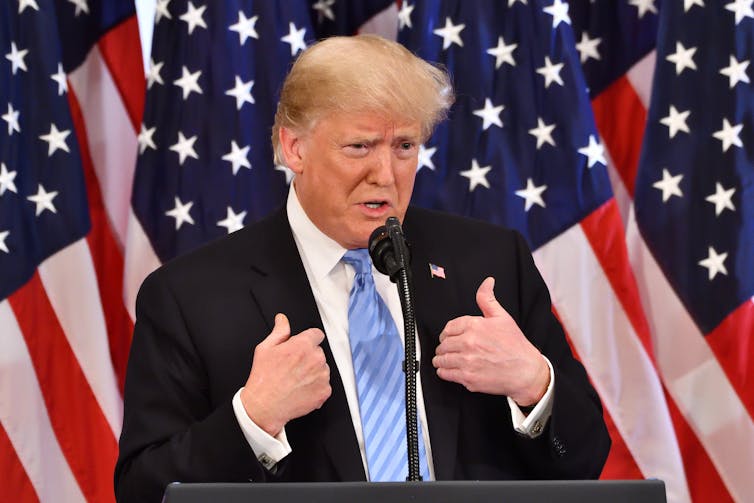
More ominously, millions of Americans voted for an ostentatiously super-rich CEO, electing Donald Trump as their president. In his acceptance speech, Trump praised his own business acumen as being key to his political success: ‘I’ve spent my entire life in business, looking at the untapped potential in projects and in people all over the world. That is now what I want to do for our country.’
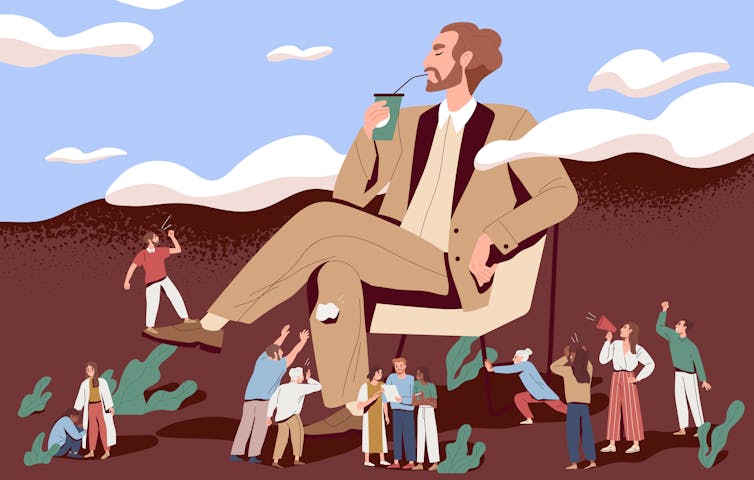
The barely interrupted veneration of the CEO as a hero, marked most expressively by the Trump presidency, has brought us to a point today where CEOs are not just valued for their skills in business but have become role models in all walks of life. We now live in what we call a ‘CEO society’: a society where corporate leadership has become the model for transforming not just business, but all human activity, where everyone from politicians to jobseekers to even those seeking love are expected to imitate the qualities of the lionised corporate executive.
The contemporary adulation and admiration of CEOs raises the question of what enabled their continued idolisation, given what could well have been their fall from grace 10 years ago? At the time, many hoped that the sad devastation of the crisis might open the door for an economic and political paradigm shift that would usher in a fairer, more equal and just society. It’s not that this promise of change has not arrived, it’s that it seems farther away than ever.
After 2008, for a brief time, people clamoured for CEOs to be held accountable and be prosecuted. This was, not least, a practical matter. With jobs being lost, shop fronts being boarded up, and politicians crying austerity, what people wanted above all else was economic recovery. Yet with the world’s top executives in disgrace, who could lead such a dramatic economic revival?
What arose from peril was a novel fantasy of executive-led recovery that allowed the shattered reputation of the CEO to stage a prompt, if not miraculous, comeback. This played into an appealing crisis narrative. With such a narrative, all faith must be invested in the recuperation of an imaginary golden past that existed before the upheaval. Most recently, this has manifested in Brexit’s investment in the promise of a renewed British sovereignty, as well as in populist political rallying cries such as ‘Make America Great Again’.
These desires for recovery and return are of course perfectly understandable, and they clearly shed light on why ideologies of free-market heroism thrived again after crisis. But this still only scratches the surface of why CEOs continue to be idolised by so many. Whereas individual executives from Martin Shkreli of Turing Pharmaceuticals to Harvey Weinstein of Miramax might be reviled for their greed, corruption or abuse of power, the CEO – as an ideal – has been reinstated with a solid-gold allure.
The financial crisis pointed to a deep insecurity rested in the fear that it was futile for humans to control the economic world that we had created, and this reverberated with a more general fear that we lack agency more widely. Suddenly, people were pushed into facing the possibility that their lives were lost to the whims and unpredictable fate of a supernatural market. Where since the advent of the 20th century it had been righteously condemned that ‘money is the secular God of the world’, now it was feared that finance had become an even more reckless God, one who cared little for the humans who worshiped at his gilded altar.
The quick rehabilitation of the image of the CEO in the popular imagination was not just a practical matter of wanting to hold on to the material benefits afforded by neoliberal capitalism. It was a psychic measure needed to counteract the fear of dehumanisation at the hands of a runaway Frankenstein economy. In other words, we just wanted to pretend that someone was in control, even if all the facts and evidence were telling us that this wasn’t the case. Everything could be forgiven if hope could be returned.
The retention of the CEO myth was an assertion of the power of individuals to shape events and control their destiny. To achieve this meant holding on to the heroic character of the CEO such that people might regain a sense of control over their own lives too.
Maintaining faith in the CEO was less a matter of empirical fact and more a symptom of a human need to find something to believe in at the end of a hard-earned day; with the reality too hard to bear, the fantasy had to return. Held out was the promise that everyone could receive grace if only he accepted the modern CEO gospel. This is the very same faith that allows people to believe that the business acumen of an impetuous, loud-mouthed, misogynist bully is able to lead America to greatness. When Trump said that he would run the US like a business project, ‘under budget and ahead of schedule’, enough people believed him to pave his way to the White House.
CEOs represent the ability to be in control of a market that appears uncontrollable and uncaring of its profound human costs. This desire for control belies the reality for too many people of being on the wrong side of the rising tide of inequality, and of being subjected to the tyranny of a new singleminded political authoritarian intolerance. Let’s hope that with the next crisis we learn that we need to let go of the fantasy of the CEO.
This article was originally published at Aeon and has been republished under Creative Commons.